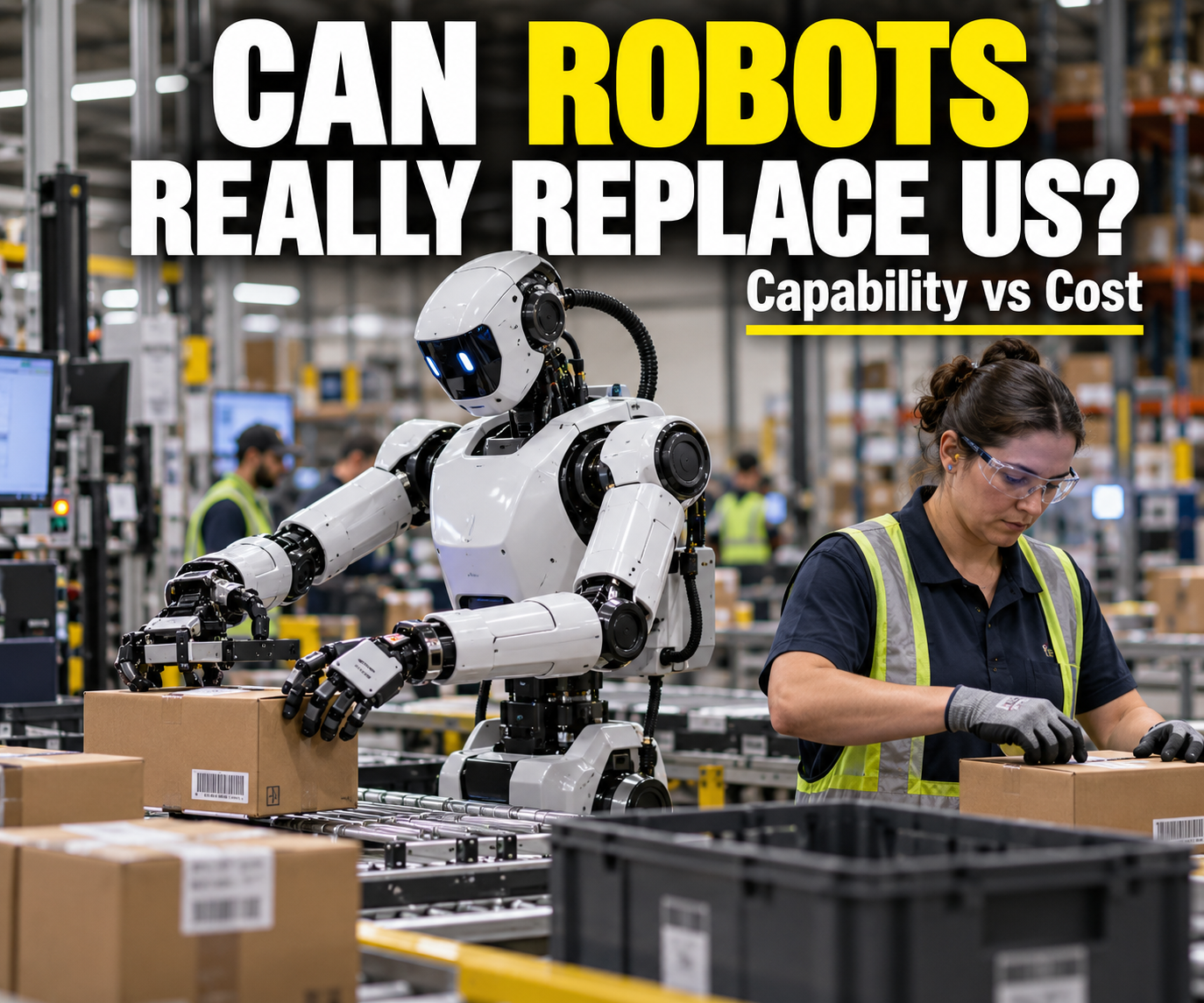
Robots are becoming increasingly capable, but a new study suggests that technical ability and practical automation are still very different things.
Researchers examined thousands of physical work tasks to determine what modern robots can actually perform and whether using a robot would make economic sense.
The headline result is striking:
Today's robots may be technically capable of performing about 74% of physical work tasks under at least some conditions.
But robots are currently estimated to be cheaper than human labour for only about 0.3% of job tasks.
That difference tells us much more about the current state of robotics than impressive demonstration videos alone.
Being capable does not mean replacing a worker
A robot successfully completing a task in a controlled environment does not necessarily mean it can replace a person doing the same work every day.
Real workplaces are unpredictable.
Objects move. Equipment differs. People walk through workspaces. Lighting changes. Tools may be positioned differently. A robot may also encounter objects it has never seen before.
Humans can usually adapt quickly to these changes.
Robots still struggle with many of them.
This is why the researchers distinguish between tasks robots can technically perform and tasks that can realistically and economically be automated.
The environment matters
Many current robots work best when their surroundings are specifically designed around them.
Factories are a good example.
Industrial robots can perform extremely repetitive tasks because the objects, equipment and working environment can be carefully controlled.
The situation becomes much harder in places such as homes, construction sites, farms, hospitals and ordinary businesses.
These environments constantly change.
The study found that only a small portion of physical work can currently be handled by robots in genuinely unstructured environments.
This remains one of the biggest obstacles facing general-purpose and humanoid robots.
Manipulation remains difficult
One of robotics' hardest problems sounds surprisingly simple:
Picking things up.
Humans can look at an unfamiliar object, estimate its weight and shape, decide where to grip it and adjust immediately if something goes wrong.
Giving robots the same ability is extremely difficult.
Modern computer vision can help robots identify objects and AI models can help plan actions, but reliable physical manipulation remains challenging.
A robot operating in the real world needs perception, reasoning, movement and physical control to work together reliably.
An error in any one of those systems can cause the entire task to fail.
Cost may be the bigger barrier
Even when a robot can perform a task, businesses still need a reason to use it.
Robots can require expensive hardware, sensors, maintenance, integration and specialised software.
Companies may also need to redesign workplaces around them.
Human workers, meanwhile, are extremely flexible.
One person can perform many different tasks without requiring the workplace to be rebuilt for each one.
That helps explain why the research estimates that only around 0.3% of job tasks are currently cheaper to perform using robots.
The economics may therefore be a bigger short-term barrier to widespread robotics adoption than raw AI capability.
AI could change the equation
This situation may not remain the same for long.
AI models are improving robot perception, planning and learning.
Instead of programming every movement manually, researchers are increasingly training robots using demonstrations, reinforcement learning and large datasets collected from real-world interactions.
Better AI could allow the same robot hardware to perform many different tasks.
Hardware costs could also fall as robotics manufacturing grows.
If both trends continue, the number of tasks that make economic sense to automate could increase significantly.
Don't confuse 74% with 74% of jobs disappearing
The study's 74% figure requires careful interpretation.
It does not mean robots can currently replace 74% of workers.
It refers to physical tasks that robots can perform under at least some conditions.
A single job can contain many different tasks, some of which may be easy to automate while others remain extremely difficult.
Robots could therefore take over individual parts of a person's job without replacing the entire occupation.
This distinction is important when discussing predictions about automation and employment.
The robotics race is only beginning
Humanoid robots and AI-powered machines are attracting enormous investment.
Companies are trying to build robots capable of working in warehouses, factories, homes and other environments originally designed for people.
But the new research provides a useful reality check.
The technology is advancing rapidly, yet technical demonstrations are only one part of the challenge.
For robots to become widespread, they must also become reliable, adaptable and economically worthwhile.
Right now, robots may be capable of more physical tasks than many people realise.
But the much more important number may be 0.3% — the tiny share of tasks where using a robot currently makes better economic sense than using a person.